How to Write a Nonfiction Book With AI: Step by Step
How to write a nonfiction book in 2026: pick your reader, check the market, research with AI, outline by book type, draft, fact check and publish.
 By Philip Ghezelbash
To write a nonfiction book, choose a specific reader, promise them a clear result, research and outline the book, then draft, edit and fact check it before you publish. In 2026 you will probably use AI for much of the drafting, and that is fine. It changes how long the book takes, not what makes it good.
AI is fast at turning notes into a draft, suggesting structure and tidying sentences. It is weak at the two things nonfiction readers care about most. It can invent statistics, quotes and even whole sources, and it has never done the thing your book is about. So less of your time goes into typing, and more goes into research, your own examples and checking every claim.
This guide is part of our guide to how to write an ebook. If you have never written a book, start with how to write a book with no experience. For more drafting prompts, see how to write an ebook with AI.
How long it takes now
For a 40,000 word how-to or business book written alongside a job, a realistic plan looks like this. These are rough estimates.
| Step | Time with AI |
|---|---|
| Reader, promise and market check | 1 to 2 days |
| Research and source file | 1 to 2 weeks |
| Outline | 1 day |
| First draft, chapter by chapter from your notes | 1 to 2 days |
| Rewrite with your experience and examples | 1 to 3 weeks |
| Fact check | 2 to 5 days |
| Edit, title, cover and publish | 1 to 2 weeks |
That is roughly five to ten weeks, where the draft alone used to take months. Research and checking now set the pace, not typing. Memoir and research-heavy history take longer.
Pick your type of nonfiction
Each type has its own shape. Pick one before you outline, because a book that tries to be a memoir and a method at the same time usually confuses readers.
| Type | What it does for the reader | How it is usually built | Typical length |
|---|---|---|---|
| How-to or self-help | Teaches a skill or solves a problem | Problem, method, one chapter per step, mistakes, next steps | 20,000 to 40,000 words as an ebook, up to 70,000 as a full book |
| Expert or business | Builds your authority and explains a framework | Big idea, one chapter per part of the framework, case studies | 30,000 to 60,000 words |
| Guide or reference | Lets the reader look things up quickly | Organized by topic, with short entries and checklists | 7,500 to 20,000 words |
| Memoir | Tells your true story and what it taught you | Scenes in time order or grouped by theme | 60,000 to 90,000 words |
| Narrative nonfiction | Tells a true story built from research | A story arc with sourced facts and a clear timeline | 70,000 to 100,000 words |
Coaches, consultants and creators mostly write the first three, often at the shorter end. Memoir is where AI helps least, because the material only exists in your memory. See how long an ebook should be for more on length.
Step 1: Choose a topic and a specific reader
"Small business owners" is too wide. "Freelance photographers who want to move from one-off jobs to monthly retainers" is a reader you can write for. Write down what they already know, what they have tried, and what "solved" looks like for them. AI is a useful sounding board: ask it to list the questions that reader would type into a search box, then check which ones you can answer from experience.
Then ask why you are the right person. Credibility comes from results you have achieved, years doing the work, or serious research and interviews. You need at least one. For ideas, see ebook ideas and ebook niches that sell.
Step 2: Check the market
Search your topic in the Kindle store, open the top five to ten books, and note the title and subtitle, the length and table of contents (use Look Inside), the ratings, and the Best Sellers Rank in the product details.

A lower rank number means more sales. Our Amazon book sales calculator turns a rank into a rough range of daily sales, and the KDP category finder suggests categories for your book.
Then read the three and four star reviews. They tell you what is missing. If readers keep saying a book is too theoretical, out of date or too long, you have found your angle. You can paste a handful of reviews into an AI chat and ask it to group the complaints, but read some yourself too. Competition is a good sign: what you want is proven demand and a clear gap.
Step 3: Write your promise
Every good nonfiction book can be said in one sentence. Write yours now, because it decides what stays in the book, and you will paste it into every AI prompt.
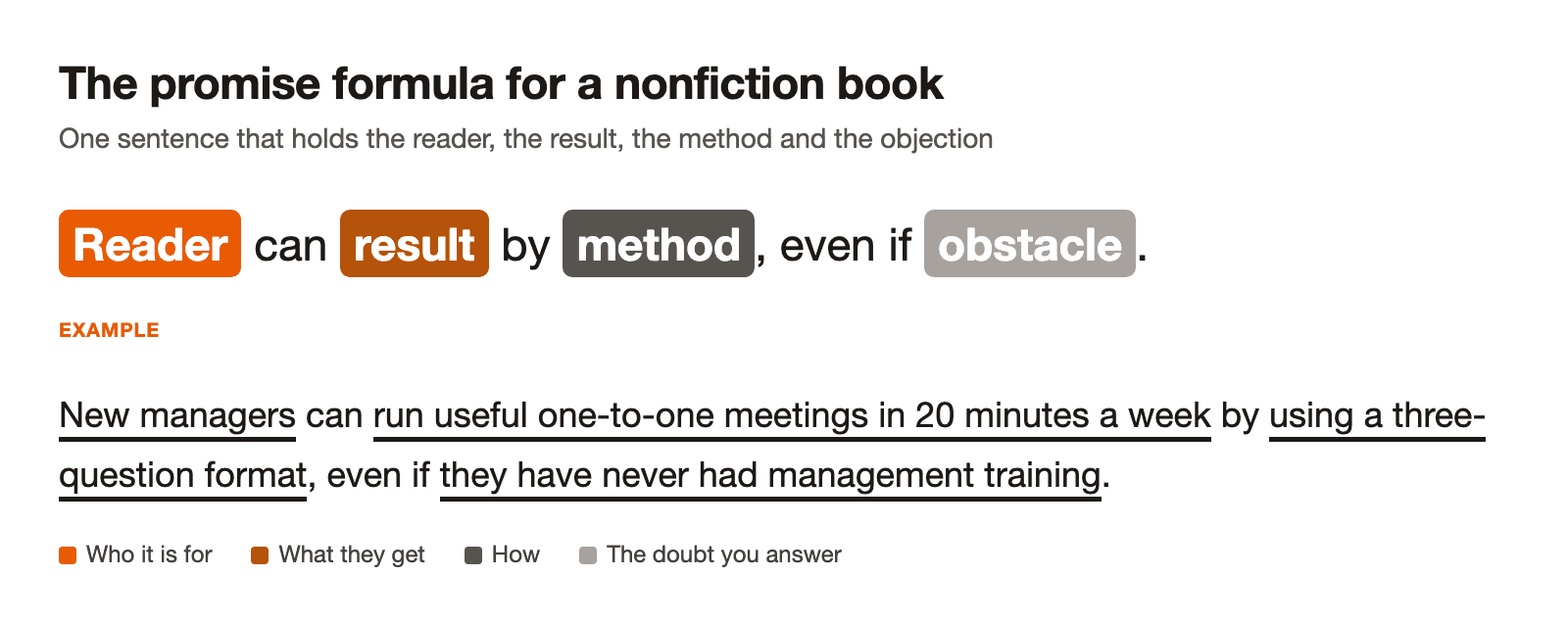
It becomes the base of your subtitle and book description, and it gives you a test for every chapter: if a chapter does not help deliver the promise, cut it. For memoir, write what the story is about and what the reader will take away instead.
Step 4: Research with AI, without trusting it as a source
Nonfiction is trusted when it is accurate. AI makes research faster, as long as you use it to find sources and never as the source.

Your strongest material is your own experience and results, then primary sources (official data, studies, laws), then interviews with people who know, then respected books and reports. A prompt like this gets you a reading list instead of unverified facts:
I'm writing a nonfiction book for first-time managers about running short weekly one-to-one meetings. I want to make this claim in chapter 1: most new managers get little or no training before they start. Tell me which kinds of primary sources could support or contradict it, such as surveys, studies or official statistics, and name the organizations that publish them. Do not give me any statistics yourself.
Open each source, read the relevant part, and log it in a simple source file. A few rows for the example book might look like this (made up for illustration):
| Claim in the book | Where it came from | Checked |
|---|---|---|
| My one-to-ones went from 45 to 20 minutes | My own calendar, March to June | Yes |
| Quote from a team lead about her first one-to-one | Interview on 3 May, notes saved | Sent to her to approve |
| A survey figure on manager training | The original report, not a news story about it | Figure and year match |
Set a limit, such as two weeks, so research does not replace writing. Summarize in your own words, credit your sources, keep quotes short, and get permission before sharing someone's private story. (This is general guidance, not legal advice.)
Step 5: Outline the book
For a how-to or expert book, this order works for most topics: an introduction, the problem, your method, one chapter per step, mistakes and troubleshooting, case studies, and next steps. For memoir, outline by scenes. For narrative nonfiction, outline the story arc and attach your research to each point.
Then give every chapter the same shape. It makes the book easier to read and gives the AI a pattern to follow.
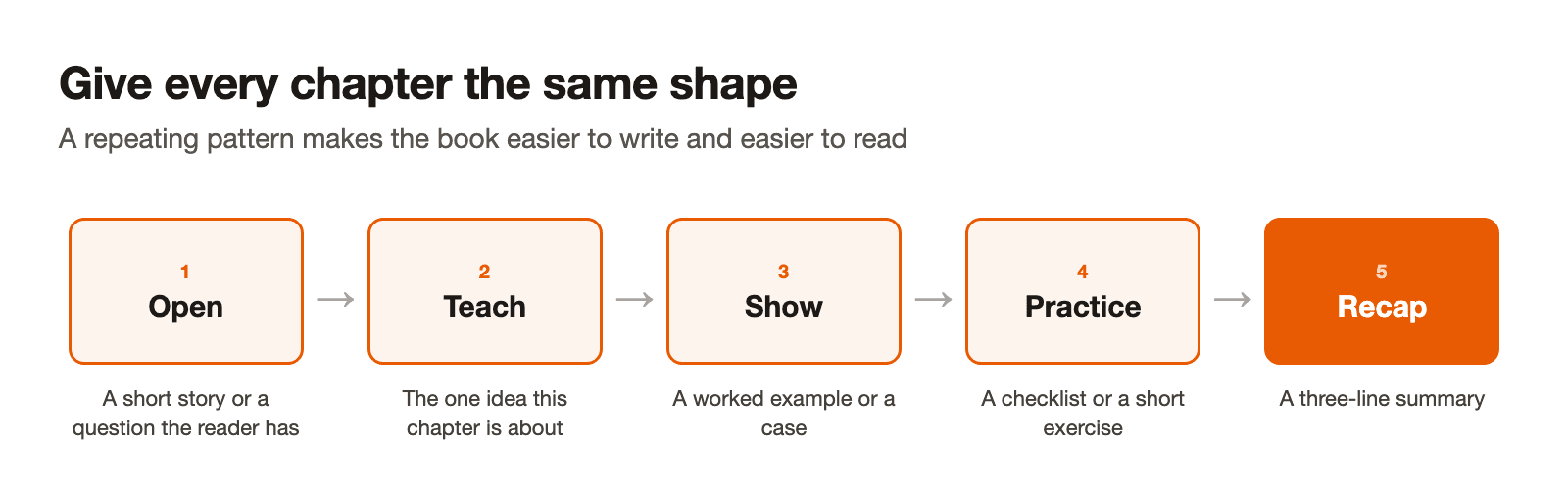
AI is quick at a first outline. Give it your promise, book type and research notes, or put a one-line description into the ebook outline generator. Here is what it suggested for the one-to-one meetings book:
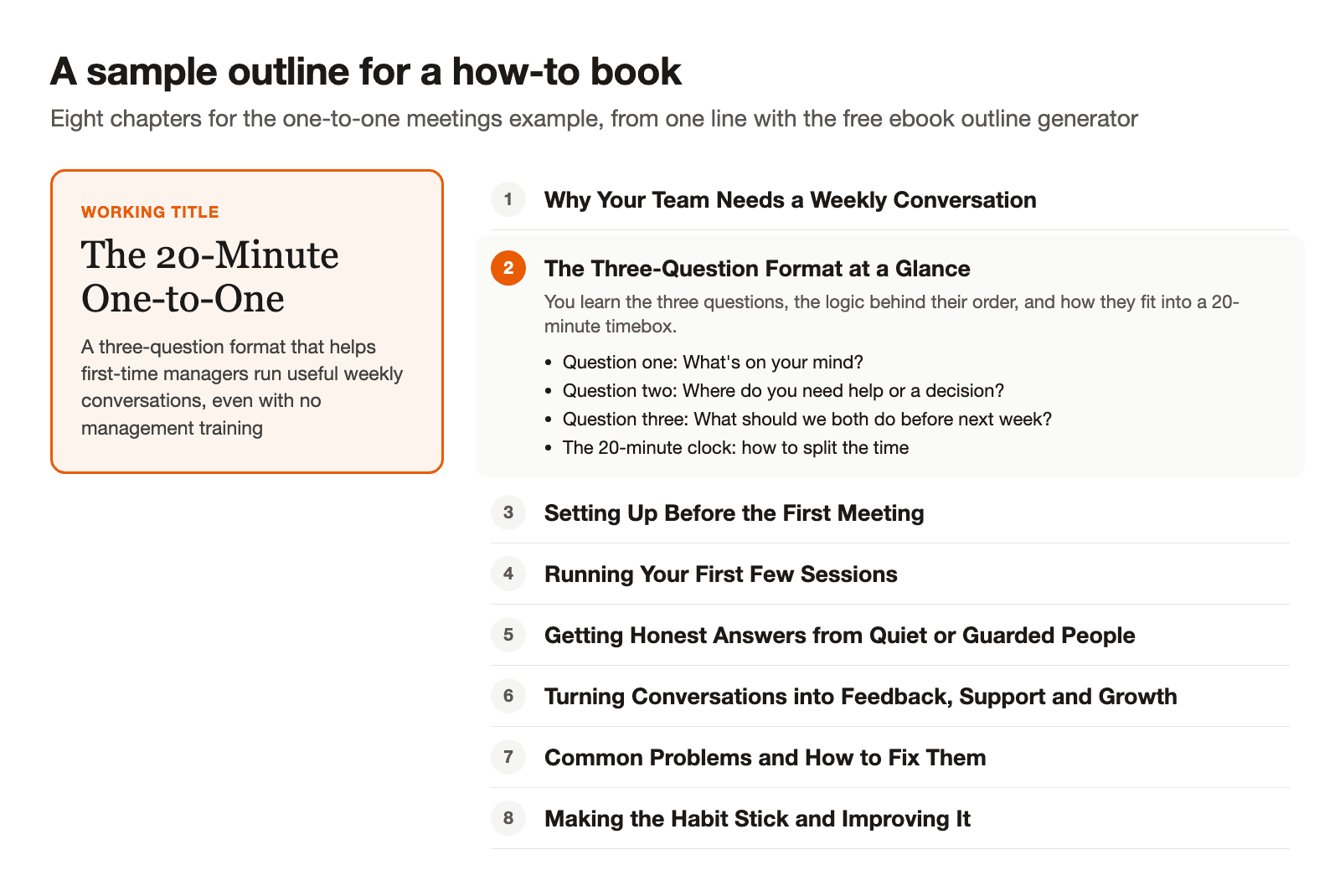
Then edit it hard. Does every chapter deliver part of the promise? Is a step missing? Do you have a real example and a source for each chapter?
Step 6: Draft from your notes, one chapter at a time
Draft the body chapters first and write the introduction last. For each chapter, give the AI your promise, the outline, a summary of earlier chapters, and your notes and sources, and tell it not to fill gaps on its own.
Below are my book's promise, the outline, a summary of chapters 1 and 2, and my notes and sources for chapter 3, "Setting Up Before the First Meeting." Write a first draft of about 4,000 words using only my notes and sources. Open with a short story from my notes, teach the idea, show a worked example, and end with a checklist and a three-line summary. Where you need a fact, figure or example I have not given you, write [SOURCE?] instead of making one up.
Expect a draft that is clear, organized and a little bland. That is raw material. Our guide to writing a book with ChatGPT shows how to carry context between chats, and book tools such as Koobe keep the outline and earlier chapters in view for you.
For memoir, flip the order: write or dictate each scene yourself, then use AI only to tidy the prose. If AI writes your memories, they stop being yours.
Step 7: Fact check every claim
AI makes this step more important, not less. Fill each [SOURCE?] marker with something you have confirmed, or cut the sentence. Then ask the AI for a checklist:
List every factual claim in this chapter: numbers, dates, names, quotes, and any statement about what research or experts say. For each one, say what kind of source would confirm it. Do not judge whether the claims are true.
Check each claim yourself, against the original. Do not ask the AI whether its own facts are right, because it can confirm a mistake as confidently as it made it. Soften claims that are only partly backed up ("often" instead of "always"), and make sure anything that depends on a date or a law is current.
Step 8: Edit and make it yours
Edit in passes: structure first, then voice, then clarity, then a proofread. The voice pass matters most with AI. Replace generic sentences with your own stories, results and opinions, and cut anything that could appear in any book on the topic. Then ask two or three people from your target readership where they got lost or bored. If you hire help, our breakdown of what it costs to self-publish a book shows where editing money goes furthest.
Step 9: Write the title, subtitle and cover
A good title is short and memorable. A good subtitle names the reader and the result. Bestselling nonfiction follows the same pattern:
| Title | Subtitle |
|---|---|
| Atomic Habits | An Easy & Proven Way to Build Good Habits & Break Bad Ones |
| Deep Work | Rules for Focused Success in a Distracted World |
| Profit First | Transform Your Business from a Cash-Eating Monster to a Money-Making Machine |
| Never Split the Difference | Negotiating As If Your Life Depended On It |
| So Good They Can't Ignore You | Why Skills Trump Passion in the Quest for Work You Love |
AI is good at giving you 20 options to react to. Pick one and refine it yourself, or try the ebook title generator.
Your cover has to read at thumbnail size, and our guide on how to design an ebook cover shows what works. Take care with the book description too, since it is where you earn trust: state your credentials and results plainly. The book description generator gives you a first draft to rewrite.
Step 10: Publish
Most coaches, creators and first-time authors self-publish: it takes weeks instead of a year, and you keep control of the title, cover and price. Traditional publishers usually want a book proposal and an existing audience, and if you plan to pitch one, ask about their AI policy first. Our guide on how to self-publish an ebook covers the whole process, from files to stores.
Stores have AI rules. Amazon KDP asks you to disclose AI-generated text, images and translations, and if an AI tool drafted the text, it counts as AI-generated even after heavy editing. If you wrote it and used AI only to edit or brainstorm, that is AI-assisted and needs no disclosure. Kobo declines books that are wholly or partly AI-generated. Our guide on publishing a book written by AI on Amazon covers each store.
Common mistakes when writing nonfiction with AI
- Publishing facts you have not checked. AI invents numbers and sources.
- Using AI as a source. Ask it where to look, then read the source yourself.
- Leaving out your experience. Without your stories and results, the book reads like every other AI book.
- Writing for everyone. A book for every reader helps none of them.
- Padding to hit a word count. AI makes it easy, and readers notice.
FAQ
Can AI write a nonfiction book for me?
It can draft one from your notes, outline and sources. It cannot supply your experience or guarantee the facts, so plan to rewrite the draft in your own words and check every claim.
How long does it take to write a nonfiction book with AI?
For a 40,000 word how-to or business book written part time, about five to ten weeks, mostly spent on research, rewriting and fact checking.
Do I need to be an expert to write a nonfiction book?
You need to be credible, not famous. Results, experience doing the work, or serious research and interviews all count. Our guide on writing a book with no experience covers this.
Is it okay to use AI for research?
Yes, to find sources and to summarize what you have already read. Not as the source itself. Always open the original before you cite a number, a study or a quote.
Your next step
This week, write your promise sentence and a one-page outline, then gather notes and two or three solid sources for your first chapter. With those in hand, AI can help you draft quickly, and the rest is rewriting and checking.
Describe your book in a sentence. Koobe plans the chapters, writes them, designs the cover and exports a PDF and EPUB. Your first book is free to create and preview.

“Files were ready for KDP, which is what I actually needed. First book I’ve finished.”