10 Most Profitable Ebook Niches in 2026 (With Data)
10 ebook niches with strong reader demand in 2026. See monthly search numbers for each, what to sell next and how to test a niche before you write.
 By Philip Ghezelbash
The most profitable ebook niches in 2026 are the ones where many people already look for books, they pay to solve the problem, and you have something to sell after the book. Ten niches pass that test: faith and spirituality, leadership and sales, self-improvement, parenting, personal finance, Stoicism, mindfulness, AI skills, health and fitness, and dog training. Each one draws about 2,400 or more US searches a month for books on the topic.
This is not an income promise. Amazon does not publish what a niche earns, so we ranked by demand and by what you can sell next. One surprise from the data: people search for "books," not "ebooks." Only 3 of the 46 "ebook" phrases we checked reached 100 searches a month.
Updated October 2026. We refresh the search numbers each quarter.
How we picked these niches
We checked 100 phrases in Semrush (US searches, pulled on 10 October 2026), such as "parenting books" and "dog training books," and added up the related ones for each niche. Then we kept the niches that pass three tests.
| Test | What we looked at | Why it matters |
|---|---|---|
| Demand | Monthly US searches for books on the topic | Shows how many people are looking |
| Fit | Nonfiction one author can write from experience, with no single-condition medical topics | Keeps the list practical and safe for a first book |
| Next product | A course, coaching, workshop or template pack that follows the book | A book earns more when it leads somewhere |
Two limits to keep in mind. The searches are for books in any format, print included, and related phrases add up, so read each total as a size guide, not a headcount. We also did not measure competition on Amazon, since sales numbers are not public. The one-hour check later in this article shows you how to test any niche yourself.
The 10 niches at a glance
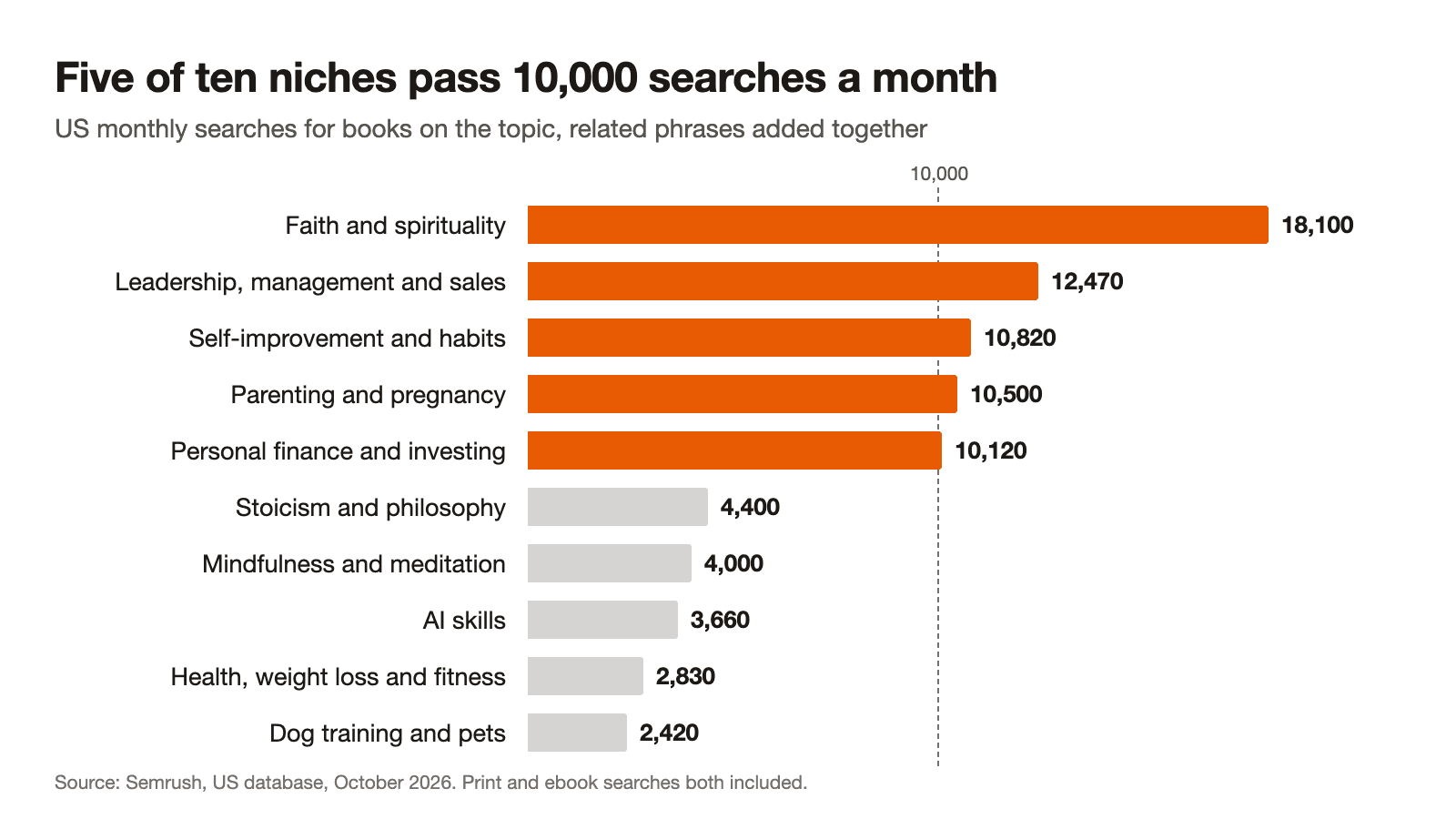
Read the bars as how many people look for books on each topic every month. They show demand, not what any book earns.
The longest bars come from broad phrases like "christian books" and "self improvement books," so a narrow book matters most there. The shorter bars are smaller but still draw thousands of searches a month.
| Niche | Biggest search phrase | Sell next | Care needed |
|---|---|---|---|
| Faith and spirituality | christian books | Study guide, journal, workshops | Low |
| Leadership, management and sales | leadership books | Workshops, training, consulting | Low |
| Self-improvement and habits | self improvement books | Workbook, challenge, community | Low |
| Parenting and pregnancy | parenting books | Planners, short course, parent group | Medium |
| Personal finance and investing | personal finance books | Spreadsheets, coaching, newsletter | High |
| Stoicism and philosophy | stoicism books | Journal, daily email, course | Low |
| Mindfulness and meditation | mindfulness books | Audio, live group, membership | Medium |
| AI skills | ai books | Prompt pack, training, consulting | Low |
| Health, weight loss and fitness | menopause books | Plans, coaching, community | High |
| Dog training and pets | dog training books | Video course, sessions, training log | Medium |
Care needed: High means health or money claims that a professional should review. Medium means safety or wellbeing advice that should stay general.
The 10 niches
They are ranked by combined monthly US searches for books on the topic. For specific book ideas inside these niches, see our 62 ebook ideas by niche.
1. Faith and spirituality
This is the biggest niche in our data, and "Christian books" is the single largest phrase we checked. The trade agrees that readers are active here: the Association of American Publishers (AAP) reported that sales at religious presses grew 9.3% in 2025 to $2.2 billion, the largest gain of any category in its report.
The catch is that the broad phrase also covers fiction and the big publishers, and searches for "ebooks" in this niche are tiny ("devotional ebook" gets about 10 a month). People look for books, so write a book. Pick one group and one need, such as a 30-day devotional for new mothers or a Bible study guide for small groups. Write from your own tradition and say so.
Sell next: a small-group study guide, a printable journal, workshops for churches.
2. Leadership, management and sales
"Leadership books" leads this niche, with "sales books," "management books," "negotiation books" and "public speaking books" behind it. The buyers are working professionals who want to do their job better, so they will pay for a clear answer.
Practical beats inspirational here. Write for one role and give readers things to copy: scripts, checklists and meeting templates. "A first-time manager's guide to hard conversations" will do better than "Leadership secrets."
Sell next: workshops, team training, consulting. This is the best fit if you are a coach or consultant, because the book also works as a calling card.
3. Self-improvement and habits
"Self improvement books" is a huge phrase, and "habit books," "time management books" and "productivity books" add to it. Expect to compete with well-known authors on the broad searches, so narrow the book to one person in one situation: habits for night-shift nurses, time management for parents of toddlers, a 30-day reset for people returning to work.
Sell next: a workbook, a 30-day challenge, a paid community.
4. Parenting and pregnancy
"Parenting books" is one of the largest single phrases in the data, and "pregnancy books" brings a second audience of people who are about to become parents. Parents look for help at specific moments, so write for a moment: the first month home with a newborn, a plan for the second parent, getting a family ready for the school year.
Take care: share your own experience and reliable sources, avoid medical advice, and have a professional review anything about health or safety.
Sell next: printable planners, a short course, a parent group.
5. Personal finance and investing
"Personal finance books" leads here, followed by "trading books," "real estate investing books," "stock market books" and "retirement planning books." Money problems depend on the country and the stage of life, so write for one of each: money for the first year of freelancing, a first budget for new graduates.
Take care: keep it to general education, say plainly that it is not personal financial advice, and check every figure and rule for the country you write about. Never promise returns.
Sell next: budget spreadsheets, coaching, a newsletter.
6. Stoicism and philosophy
"Stoicism books" is a large phrase for a single topic. Readers want calm, practical ways to handle work, money, health and relationships, not a history lesson. Applied beats academic: Stoicism for new managers, for parents, for athletes, or as 30 short daily readings. The ancient texts are in the public domain, but many modern translations are still under copyright, so quote carefully or use your own words.
Sell next: a daily-reflection journal, a daily email, a short course.
7. Mindfulness and meditation
"Mindfulness books" and "meditation books" together draw about 4,000 searches a month. This niche rewards practice over theory: short sessions, scripts and daily readings a reader can follow in five to ten minutes. Pick a setting where people are short on time, such as desk workers or teachers before the school day.
Take care: present it as a practice, not a treatment. Do not promise to cure anxiety, depression or sleep problems.
Sell next: audio recordings of the sessions, a live group, a paid membership.
8. AI skills
"AI books" draws a large number of searches, and the buyer is clear: a professional who has to use AI at work and wants to know how. Practical beats general here too. Write AI for teachers, for real estate agents or for accountants, with examples readers can copy and paste.
The catch is that tools change quickly. Teach the method rather than the button clicks, put the date on the book, and plan to update it. An ebook is easy to update, which helps.
Sell next: a prompt pack, team training, consulting.
9. Health, weight loss and fitness
Weight loss, keto, intermittent fasting, strength training, sleep and menopause books together add up to a big niche, and "menopause books" is its largest single phrase. It is also the niche where a mistake costs the reader the most.
Write it only if you have the experience or credentials to back it up. Stick to general information from reliable sources, avoid promising results, and have a qualified professional review the manuscript. A narrow, honest book, such as a beginner's strength plan for people returning to exercise after a break, is safer and easier to sell than a big promise.
Sell next: workout or meal plans, coaching, a paid community.
10. Dog training and pets
"Dog training books" is the smallest niche on this list, and a low-difficulty one in Google (difficulty 19 out of 100 for the main phrase). The readers are new puppy owners, rescue adopters and people with a problem to fix today, such as barking or pulling on the leash. The best books are step-by-step plans: the first 30 days with a rescue dog, leash training for apartment dwellers. Photos help, so add a few.
Take care: for serious behavior problems like aggression, tell readers to see a qualified trainer or a vet.
Sell next: a video course, one-to-one sessions, a printable training log.
Just below the cut were photography, and relationships and dating.
How to check any niche in an hour
Search numbers tell you people are looking. This check tells you whether you can win a share of them. Try these steps in order.
- Search the Kindle store. Type the niche's main phrase and scan the first page. Recent books with real review counts are a good sign, because readers exist. A page of old books with few reviews usually means a quiet niche.
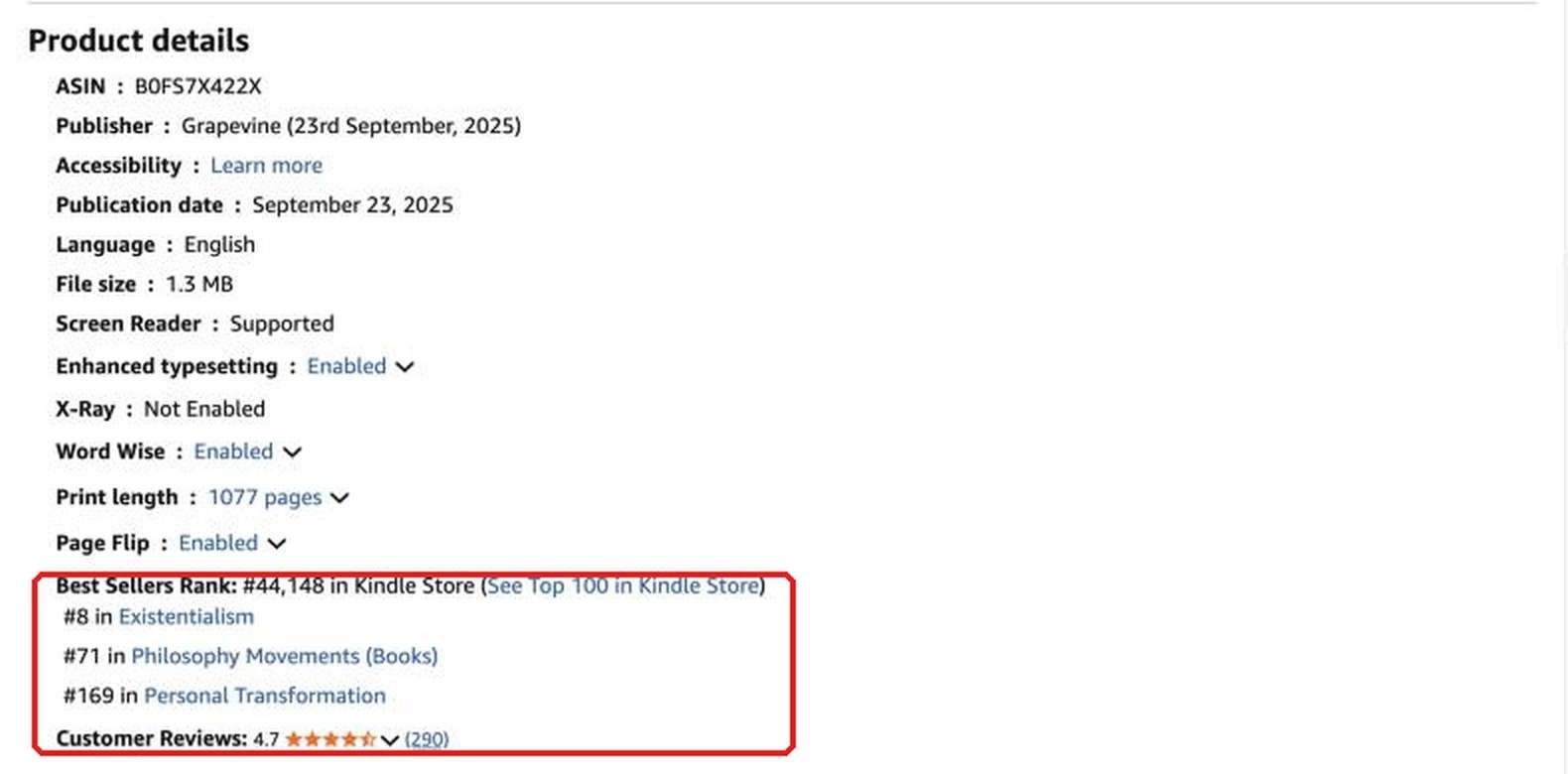
- Open the top ten books. Under Product details, note each book's Best Sellers Rank and how many ratings it has. Several books with steady ratings in your corner of the niche show the demand is real.
- Read the three-star reviews. They say what is missing: "too basic," "no examples," "written for the UK." That gap is your opening.
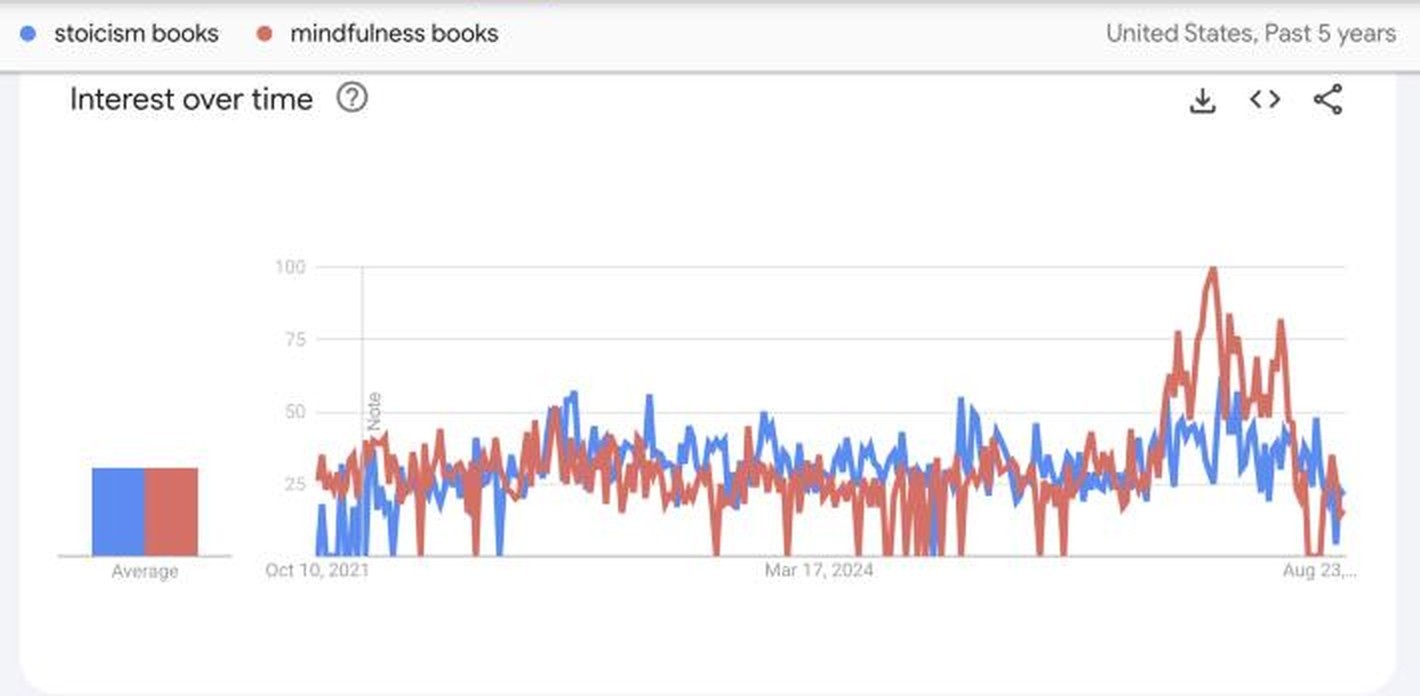
- Check Google Trends. Look for interest that is steady or rising, not a spike from one news story.
- Name your next product and your first 100 readers. Where will they come from: an email list, a community, a store category? Our free KDP category finder can help you find the categories to look in. If you cannot name either one, pick a different niche.
Here is what steps 2 and 4 look like in practice.
A five-question scorecard
Score your niche from 1 to 5 on each question, then add them up.
| Question | A score of 5 looks like |
|---|---|
| Do readers exist? | Several recent books with hundreds of ratings |
| Is there a gap? | Three-star reviews keep asking for the same missing thing |
| Is interest steady? | A flat or rising line on Google Trends, with no single spike |
| Can you reach 100 readers? | You can name the list, community or category where they gather |
| Do you know this topic? | You can write with real examples, not just research |
20 or more out of 25 is a good sign to start. 15 to 19 means narrow the idea and check again. Under 15, pick another niche. These cutoffs are our rough guide, not a formula.
Niches to be careful with
Some topics need extra care, however many people search for them.
- Single medical conditions. Books on ADHD and grief drew real searches in our data. We left them out because a wrong claim can hurt a reader. If you write one, have a qualified professional review it.
- Legal and tax advice. Rules change by country and by year. Stay general and tell readers to check their own situation.
- Broad, crowded topics. "Self improvement" and "business success" have no clear reader. Narrow the book to one person and one problem.
- Copies of other books. Summaries and look-alikes of a recent bestseller can break store rules and harm your reputation.
Low-content books such as coloring books, puzzle books and trivia books are not covered here. They sell differently, and Koobe focuses on nonfiction.
FAQ
What is the most profitable niche for ebooks?
Nobody can say for certain, because Amazon does not publish earnings by niche. The safer answer is the niche where you have real experience, can name your reader in one sentence and have something to sell after the book. Use the ten above as a map of where readers are, then choose the one that fits you.
How many books do I need to sell to make $100,000?
It depends on the price. This is the math at KDP's 70% ebook royalty:
| List price | Royalty per sale | Sales for $100,000 |
|---|---|---|
| $2.99 | $2.05 | about 48,800 |
| $4.99 | $3.45 | about 29,000 |
| $9.99 | $6.95 | about 14,400 |
The royalty is 70% of the price after KDP's stated average delivery cost of $0.06 a sale (larger files cost more). The table ignores VAT, income tax and ad spend. On Amazon.com the 70% option needs a list price from $2.99 to $12.99 (the top of the range rose from $9.99 on 7 July 2026), and sales to readers outside the 70% countries earn 35%. Try your own numbers in our KDP royalty calculator, and see how to make money selling ebooks for the other ways a book can earn.
What niche is in high demand?
Five of the ten have more than 10,000 combined US searches a month for books on the topic: faith and spirituality, leadership and sales, self-improvement, parenting, and personal finance. The chart near the top shows the rest.
Are ebook sales declining?
Not overall. The Association of American Publishers reported that US ebook revenue rose 3.2% in 2025 to $2.2 billion, and trade ebooks, the consumer side, rose 3.0%. Nonfiction was weaker: Publishers Weekly reported that adult nonfiction e-book sales fell 2%. Both figures come from sales reported by publishers, so they probably miss much of what self-published authors sell on Amazon.
Is a narrow niche better than a broad one?
For a first book, usually yes. On broad searches you compete with famous authors. On a narrow one you can be the obvious choice for one reader. A narrow niche still needs readers, so run the one-hour check above before you commit.
Where Koobe fits
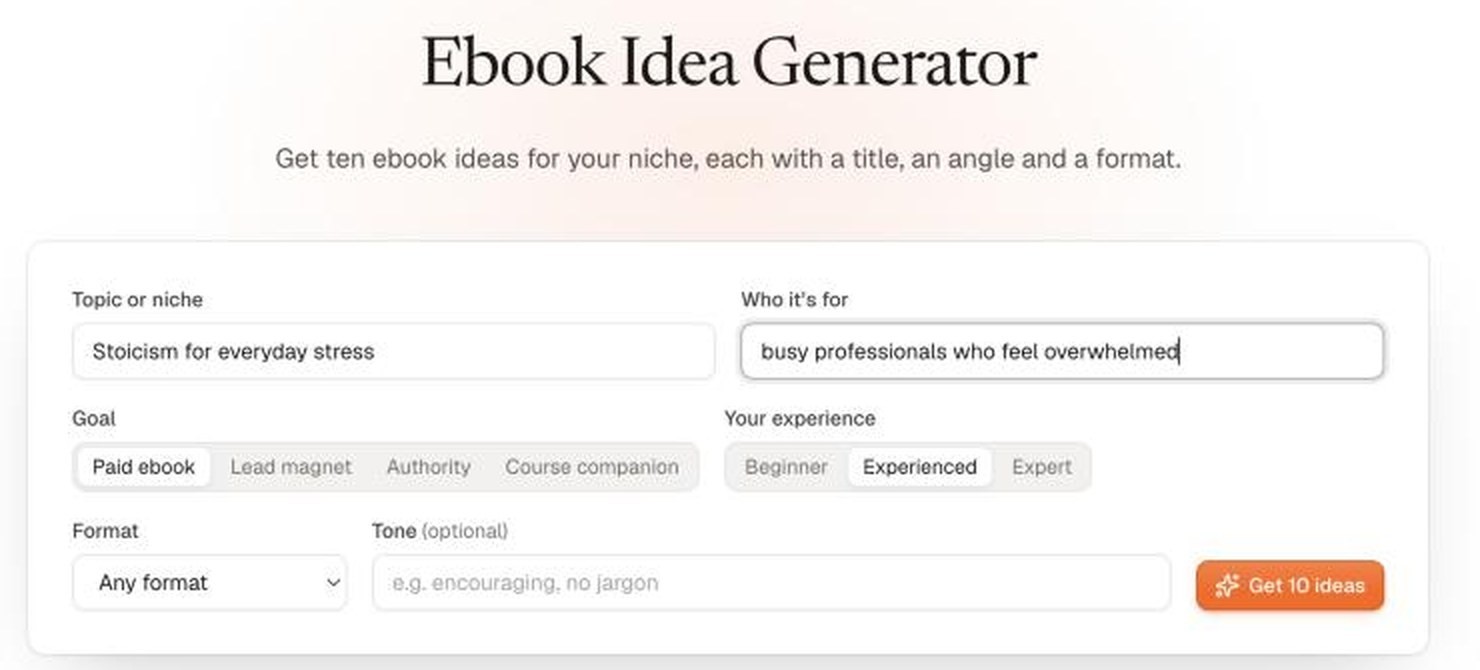
Koobe does not choose your niche or publish for you. What it does is shorten the road once you have picked one. Describe your book in a sentence, or upload your own notes, and Koobe plans the chapters, lets you edit the outline, writes the draft, designs the cover and exports an EPUB and a PDF. If you are still narrowing the idea, try our free ebook idea generator first. Your first book is free to create and preview.
Describe your book in a sentence. Koobe plans the chapters, writes them, designs the cover and exports a PDF and EPUB. Your first book is free to create and preview.

“Files were ready for KDP, which is what I actually needed. First book I’ve finished.”
The short answer, again
- The biggest niches by book searches are faith, leadership and sales, self-improvement, parenting and personal finance.
- Profit comes from a reader you can name, a narrow promise and something to sell after the book.
- Check any niche in an hour before you write: the Kindle store, the top ten books, the three-star reviews and Google Trends.