How to Use Ebooks for Marketing: 7 Strategies for 2026
Use one ebook to grow your email list, build trust and win clients. Compare 7 strategies, who each one suits and the number to track for each.
 By Philip Ghezelbash
An ebook works in marketing when it has one job: collect email addresses, build trust, help close a sale or reach a partner's audience. These 7 strategies cover the jobs that work best for coaches, consultants, course creators and small businesses, with what to do and what to track for each.
The 7 strategies at a glance
Each strategy has one goal and one number to watch, so pick by what you need most right now.
| Strategy | Main goal | Best for | What to track |
|---|---|---|---|
| 1. Lead magnet | Grow your email list | Anyone who sells a service, course or product after a first contact | Sign-up rate on the landing page |
| 2. Content upgrade | Turn blog readers into subscribers | Sites with posts that already get traffic | Sign-ups per post |
| 3. Authority ebook | Build trust and be remembered | Coaches, consultants and B2B services | Inbound requests that mention the ebook |
| 4. Sales ebook | Help prospects decide | Higher priced offers with a longer sales cycle | Calls booked and close rate |
| 5. Co-marketing ebook | Reach a partner's audience | Brands with similar audiences and different offers | Sign-ups by partner |
| 6. Low priced ebook | Win a first purchase | Creators who also sell a course or membership | Buyers who purchase again |
| 7. Speaking and podcast offer | Turn appearances into subscribers | Experts who pitch talks and shows | Sign-ups per appearance |
Ebooks still pull their weight in marketing. NetLine's 2024 report on B2B content found that ebooks were the most sought-after format, accounting for 39.5% of all demand. That is B2B data from one network, so treat it as a sign of interest, not a promise of results.
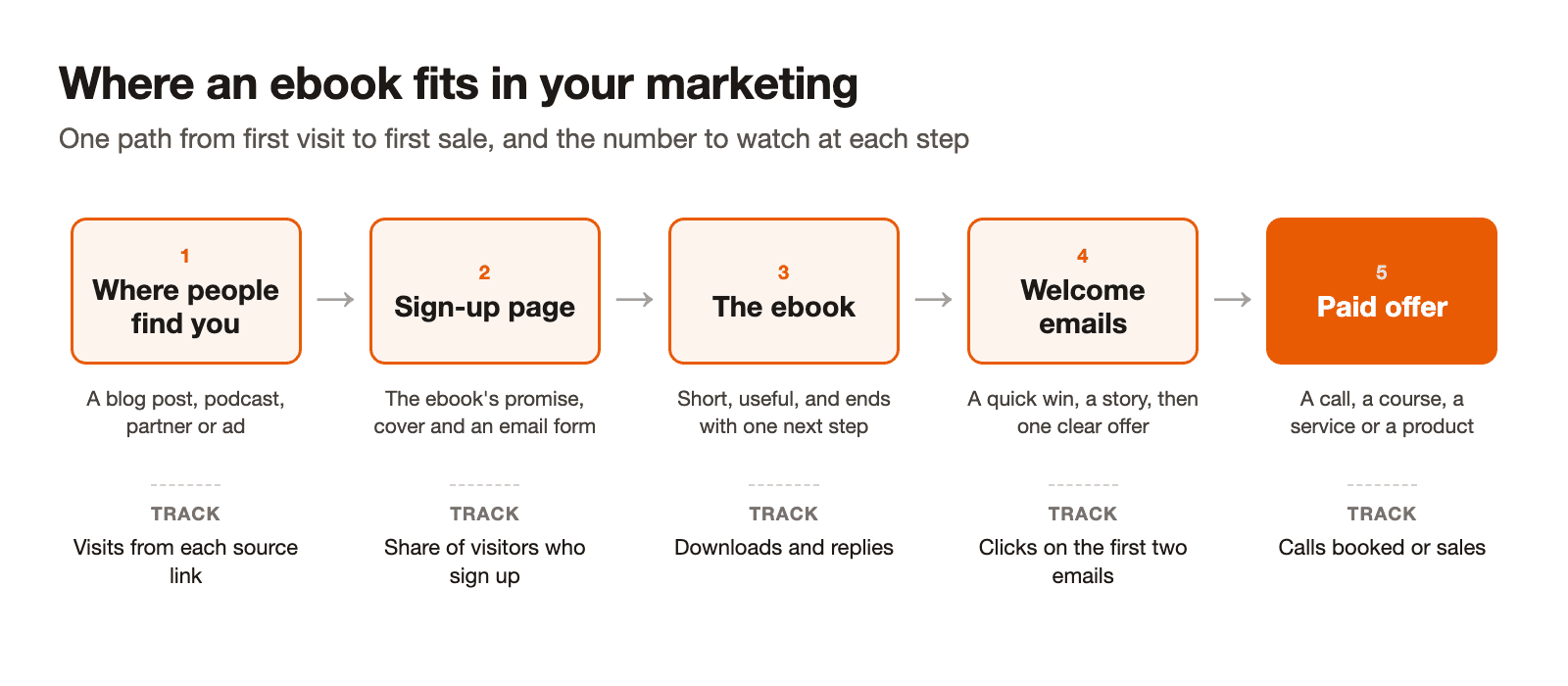
Most of these strategies follow the same path, from the place people find you to a paid offer:
1. Use an ebook as a lead magnet
A lead magnet is a short free ebook that readers get in exchange for an email address. It is the most common way to use an ebook in marketing because it gives you a list you own and a reason to write to people.
How to do it:
- Pick one problem tied to your paid offer. A narrow promise beats a broad one. "A 30-day content calendar for solo coaches" is easier to sell than "Marketing tips." Shopify's ebook guide quotes author Julie Broad on making it "valuable so someone would otherwise pay for it".
- Keep it short and finish it. Our guide to creating a lead magnet ebook covers length, structure and design.
- Collect the email before delivery. Shopify notes that you can require an email address at download, especially if you offer the ebook for free, so you build a contact list as you go.
- Send a short welcome sequence. Deliver the ebook, then follow up with a quick win, a story and one clear next step.
- Point paid traffic at the sign-up page only after it converts on its own.
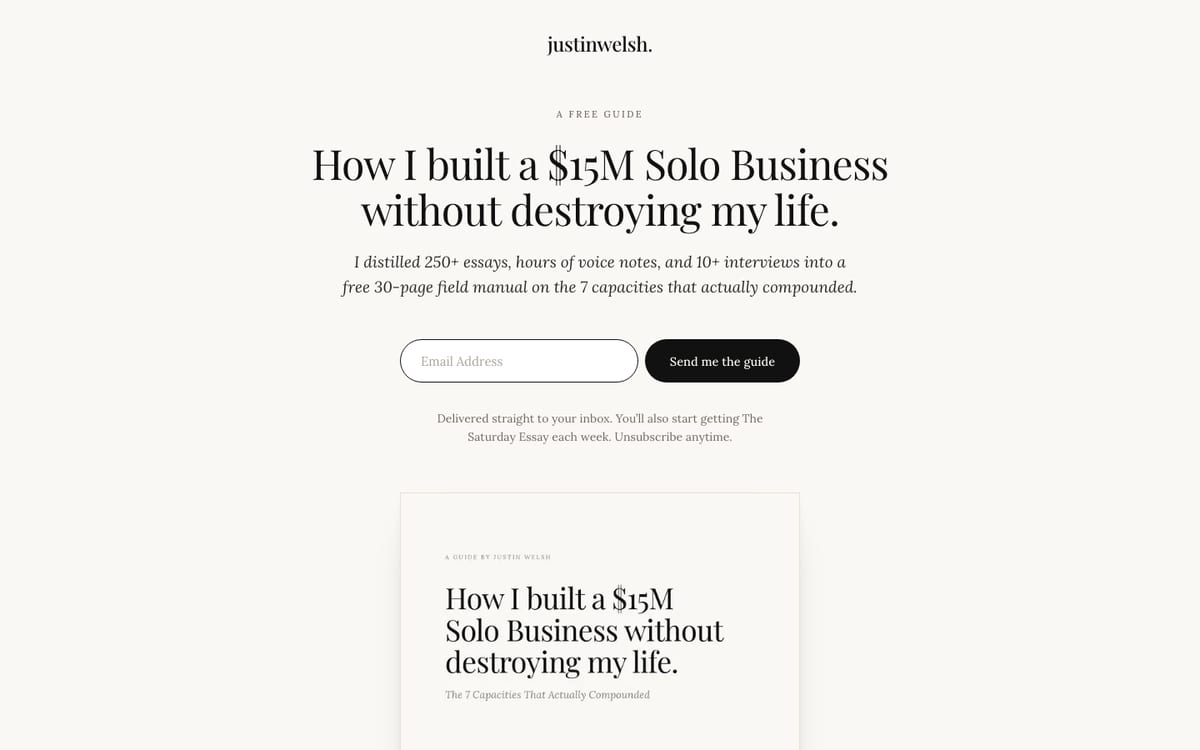
For more pages like this one, see our ebook landing page examples.
If you also sell the ebook on Amazon through KDP Select, check the rules first. KDP requires the ebook to be exclusive to the Kindle Store while it is enrolled, though you can share up to 10% of it elsewhere as a sample. So the full ebook cannot be your free download, but a sample chapter can. Our promotion guide explains the trade-off.
Track the share of landing page visitors who sign up, then the share of subscribers who buy.
2. Offer it as a content upgrade inside your best posts
A content upgrade is a lead magnet made for one blog post. Leadpages defines it as a free download that readers get for their email address, and says it "just needs to ADD value to your blog post." You do not need a long ebook. You can use a PDF version of the post, a checklist, a template or a worksheet.
The ebook version of this idea works well for sites with many posts on one topic:
- Check which posts bring the most visits.
- Find the theme they share.
- Turn that theme into one ebook with a clear promise and offer it on each of those posts.
EditionGuard, a company that delivers ebooks, described this approach in 2016. Its advice was to find your 10 most popular posts and write an in-depth ebook on the theme they share. It then offered its own ebook to blog readers through a full-screen sign-up box, and reported 5 times as many email signups per week as its regular newsletter signup. That is one company's own result and it is old, so use it as a test idea, not a benchmark.
Leadpages also recommends a two-step opt-in, where the reader clicks a button before the form appears, because it "gives the appearance of giving rather than taking." Mention the offer near the top of the post as well as the end.
Track sign-ups per post. If a post gets traffic but no sign-ups, change the offer before you change the post.
3. Publish an authority ebook that shows your thinking
An authority ebook is not a giveaway for emails. It is a finished piece that shows how you think, so the people who read it remember you when they need help. Shopify's guide says that a well-written ebook can add to your credibility as an expert in your industry.
What makes one work:
- A point of view. Argue for a method, a framework or a way of choosing, not a list of generic tips.
- Your own proof. Use client results, your process or data you collected. Do not copy what everyone else says.
- A clear next step. End with one invitation, such as a call or a mailing list.
Should you gate it? Our rule of thumb: ask for an email if your goal is leads, and leave it open if your goal is reach. An open PDF is easier to share, link and mention. You can also sell it as a paid ebook. Our guides to selling ebooks on Amazon and where to sell ebooks cover the options.
It is hard to track directly. Add a "How did you hear about us?" question to your booking form and count how often the ebook is named.
4. Use it in your sales process
A sales ebook helps a prospect decide, so it answers the questions they ask before they buy. You send it after a first call, attach it to a proposal or place it inside a nurture email sequence.
Good formats for this:
- A buyer's guide. "How to choose a [your service]" with the criteria you would use yourself. It shows your standards and pre-qualifies the reader.
- A collection of client stories. Three to five short case studies with the problem, the work and the result. NetLine's 2024 release says case studies are 78.5% more likely to lead to a purchase decision in the next 12 months, a figure from its B2B audience. The release does not say what that is compared with.
- An objections guide. Cost, timing and risk, answered honestly, one page each.
Send it with a line that says why: "You asked about timing, so chapter 3 covers it." That turns an attachment into part of the conversation.
Track calls booked and the close rate for prospects who received the ebook compared with those who did not. Keep the comparison honest: people who read more are often more interested to begin with.
5. Co-market it with a partner
A co-marketing ebook is made by two brands with similar audiences and different offers, then promoted by both. HubSpot describes the usual setup: both partners co-create an ebook, webinar or template behind a lead form, and each partner gets a share of the downloads.
How to run one:
- Pick a partner whose audience fits yours. HubSpot suggests asking whether the audience is similar and worth growing, whether the partner has expertise you lack and whether the expected leads justify your time.
- Match goals first. If one of you wants leads and the other wants ticket sales, one project may not serve both.
- Put both brands on the page. Show both logos on the landing page and name both partners in the content.
- Write down how leads are shared. HubSpot advises a written agreement and a check of the form disclaimer with your legal team.
- Use a unique link for each partner so you can see who brought which sign-ups.
If you are a solo coach or consultant, a partner might be a complementary expert: a bookkeeper and a business coach, or a copywriter and a web designer. Each writes one chapter, and your short ebook is ready sooner.
Track sign-ups by partner and, later, which list buys more.
6. Sell a low priced ebook as a first purchase
A free subscriber has not paid yet. A buyer has, even if the price is small, and that makes the next sale easier to ask for. A low priced ebook can be that first step into your paid world, ahead of a course, a membership or a service.
Shopify's ebook guide lists two related tactics: selling on your own ebook sales page to capture customer data, and running short sales such as a 99 cent promotion to attract new readers. Selling on your own page matters because most stores do not hand you the buyer's email address.
What to check:
- Where it lives. Selling direct gives you the customer list. Our guides to selling on Gumroad and selling on Shopify compare the options, and how to price an ebook helps you choose the number.
- What comes next. Add an offer on the last page and in the thank-you email, and make it the natural next step.
- Exclusivity. If you enroll in KDP Select, you cannot sell the digital ebook elsewhere while it is enrolled. Decide before you launch.
Track the share of buyers who purchase again or join a paid program within 90 days. That is the number that tells you whether this works.
7. Use it to get speaking and podcast spots
Hosts and event organizers like a guest who brings something useful for the audience. An ebook gives you a free offer to mention at the end of a talk or show. Shopify's guide suggests pitching conferences with a chapter as a preview and chapter titles that could work as talk titles, and seeking podcast interviews.
How to set it up:
- Write a chapter list that doubles as a set of talk topics. Each chapter title should work as a pitch.
- Make one short link per appearance, such as yoursite.com/podcast-name, that leads to the same sign-up page.
- Say the offer once, clearly, with the link, and repeat it in the show notes.
- Follow up with a welcome email that mentions where they heard of you.
Track sign-ups per link. After a few appearances you will see which kind of show or event brings the readers who stay subscribed.
Which strategy to start with
Start with one. The right first move depends on what you have today.
| If this describes you | Start with |
|---|---|
| You have no email list | 1. Lead magnet |
| You have blog traffic but few subscribers | 2. Content upgrade |
| You want to be known as the expert in your field | 3. Authority ebook, then 7. Speaking and podcast offer |
| Prospects ask the same questions on sales calls | 4. Sales ebook |
| You know a partner with a similar audience | 5. Co-marketing ebook |
| You sell a course or membership and want first purchases | 6. Low priced ebook |
For most coaches, consultants and course creators, the lead magnet is the right first one. It builds the list that every other strategy uses.
How to tell if it is working
Give every ebook its own link for each place you promote it, then check the same few numbers each month.
- Landing page sign-up rate. Visitors who give their email, divided by all visitors.
- Sign-ups by source. Your blog, a partner, a podcast and an ad each get their own link.
- Email replies and clicks on the first two emails after the download.
- Calls booked or sales from subscribers who got the ebook.
The value of the ebook is roughly subscribers x the share who buy x the average sale. With example numbers, 500 subscribers x 2% buying x $200 is $2,000. These are not benchmarks. Use your own.
You will find landing page benchmarks online. BookSpace, which sells an ebook platform, quotes 25% to 45% for warm traffic and 10% to 25% for cold traffic but cites no source for them. Treat them as a rough guide at best and compare against your own history.
Mistakes that waste an ebook
- No next step. An ebook that ends on a summary page gives readers nothing to do. End with one invitation.
- Too broad or too long. One problem, short and finished, beats a full book. See how long an ebook should be.
- Gating everything. If your goal is reach, an email wall costs you shares.
- No follow-up. A download with no welcome email is a wasted sign-up.
- Selling hard in every chapter. Julie Broad, quoted by Shopify, says a lead magnet should be valuable enough that someone would otherwise pay for it. A brochure does not pass that test.
- Unchecked facts. If AI helped with the draft, verify every claim and number before it goes under your name.
- No tracking. Without separate links you cannot tell which effort worked.
FAQ
How can ebooks be used for marketing?
Seven main ways: as a lead magnet, a content upgrade, an authority piece, a sales aid, a co-marketing project with a partner, a low priced first purchase and the free offer behind speaking and podcast appearances. Each one has a different goal, so pick by what you need most.
What is the difference between marketing an ebook and marketing with an ebook?
Marketing an ebook means promoting a book to get it sold. Marketing with an ebook means using it to grow a business. This guide covers the second. For the first, read how to promote an ebook.
Are ebooks still effective for marketing?
They still draw interest. NetLine's 2024 report found ebooks were the most sought-after B2B content format, at 39.5% of all demand. Results depend on a specific topic and a clear promise.
Should I put my ebook behind an email form?
Gate it if your goal is leads. Leave it open if your goal is reach and authority. You can also offer a short gated version and keep the full one open.
How long should a marketing ebook be?
Short. Our lead magnet guide suggests about 2,000 to 7,500 words. BookSpace suggests 15 to 40 pages. Finish it and make it useful rather than long.
What format should a marketing ebook be in?
PDF for lead magnets and sales aids, because anyone can open it. Use EPUB if you also sell it in ebook stores. See PDF vs EPUB and our guide to the best ebook formats.
Can I write a marketing ebook with AI?
Yes. AI can draft it quickly, then you add your own examples and check every claim. Our guide to writing an ebook with AI shows the steps.
Where Koobe fits
The hardest part of an ebook for marketing is getting a good one finished. With Koobe you describe your ebook in a sentence, review the draft and export a PDF with the cover, plus an EPUB if you want to sell it in stores. Koobe also makes promo images (1600 x 900 and 1080 x 1080) for your sign-up page and social posts. Your first book is free to create and preview. Koobe also has pages for coaches, consultants and course creators.
Koobe does not replace your own examples or your fact check, and it does not build your sign-up page or email sequence, so you set those up in your own tools.
Describe your book in a sentence. Koobe plans the chapters, writes them, designs the cover and exports a PDF and EPUB. Your first book is free to create and preview.

“Files were ready for KDP, which is what I actually needed. First book I’ve finished.”